
Agripreneurial Innovation Challenge Namibia
Building home-grown solutions and strengthening food systems.
A national agripreneurship challenge to accelerate job-creating innovations across the agriculture value chain, designed for Namibia, with the potential to scale across developing markets.

Across Namibia, a consistent reality keeps emerging: high youth unemployment alongside growing pressure on food affordability and access. While extractive industries contribute significantly to GDP, they generate limited employment and minimal downstream value creation.
The Agripreneurial Innovation Challenge (AIC) exists to support innovators and enterprises applying innovation, business skills and technology to improve efficiency, productivity and profitability in agriculture, with a strong focus on job creation, stronger value chains, and climate-smart outcomes.
The Agripreneurial Innovation Challenge (AIC) seeks to accelerate the creation and growth of businesses that apply innovation and technology to strengthen the agriculture value chain. The challenge supports solutions that can create meaningful jobs (SDG 8), increase food production (SDG 2), reduce climate impacts on agriculture (SDG 13), and support sustainable energy, production and communities (SDGs 7, 11, 12).
Eligibility: Who Can Apply?
Applications are open to innovators and enterprises at varying stages of development, including:
- Very early-stage innovators: individuals, inventors or farmer groups with functional prototypes, e.g. small biogas units, smart irrigation, robotics tools.
- Early-stage entrepreneurs: registered SMEs with pilot-stage innovations
- Growth-stage enterprises: firms ready to scale proven technologies, e.g., agrivoltaics, waste-to-value, renewable-powered agro-processing.
Qualifying Criteria
Applicants should meet the following baseline criteria:
- Applicants may be at idea stage, but must demonstrate clear commitment to reach final judging rounds, typically being proof of concept, prototype, or a first reference customer.
- Must be located in Namibia or, if international, must be committed to piloting innovation in Namibia.
- Must have a positive climate impact and be willing to participate in the GCIP/UNIDO Climate Impact Calculator (minimum target: >6.8t CO2eq/year reduction in Year 1, as referenced in the project document).
- Must participate in all programme phases, including required impact measurement steps.
- Must show a credible path to creating a significant number of new jobs over the life of the business.
Namibia faces persistent unemployment and limited access to healthy, affordable food. Structural constraints include very limited arable land (about 1%), high reliance on imported food, and vulnerability to climate shocks such as drought and water scarcity. At the same time, the economy’s over-reliance on commodity exports limits value addition and job creation.
The AIC is designed to help surface and support practical innovations that strengthen Namibia’s agriculture value chain, improve productivity and value addition, and create jobs, while building solutions that can also scale beyond Namibia.
Challenge Objectives
The AIC aims to:
- Enable farmers to improve productivity and profitability
- Strengthen value creation and innovation across the food value chain
- Advance integrated water, energy and agricultural systems for sustainability
- Enhance energy/resource efficiency while reducing Namibia’s carbon footprint
- Reduce dependence on agricultural imports
- Create new, family-sustaining jobs (especially for youth and women)
- Foster collaboration among farmers, cleantech startups and research institutions
- Strengthen national food security and climate resilience
- Support innovations/technologies/services that strengthen the above objectives
- Require selected semi-finalists to use the GCIP/UNIDO Climate Impact Calculator to determine emissions impact
What We Are Looking For
We are looking for applied innovations in the agriculture value chain that demonstrate:
- Clear job creation potential
- Strong relevance to food production, productivity, value addition, climate resilience, and/or integrated water-energy-agriculture systems
- Practicality and feasibility, beyond theory
- A pathway to scaling, including potential beyond Namibia
- Willingness to measure and communicate climate impact through the required tools
What We Are NOT Looking For
To keep submissions high quality, this challenge is not looking for:
- Ideas with no credible commitment to progress beyond concept stage (no proof of concept or prototype)
- Solutions with unclear job creation pathways
- Non-English submissions (all submissions must be in English)
- Incomplete applications or submissions that do not follow the platform process
How to Register & Apply
Step 1
Register on the platform
Step 2
Submit your qualifying round application
Step 3
If shortlisted, participate in impact measurement training and submit an initial impact projection by 30 May 2026
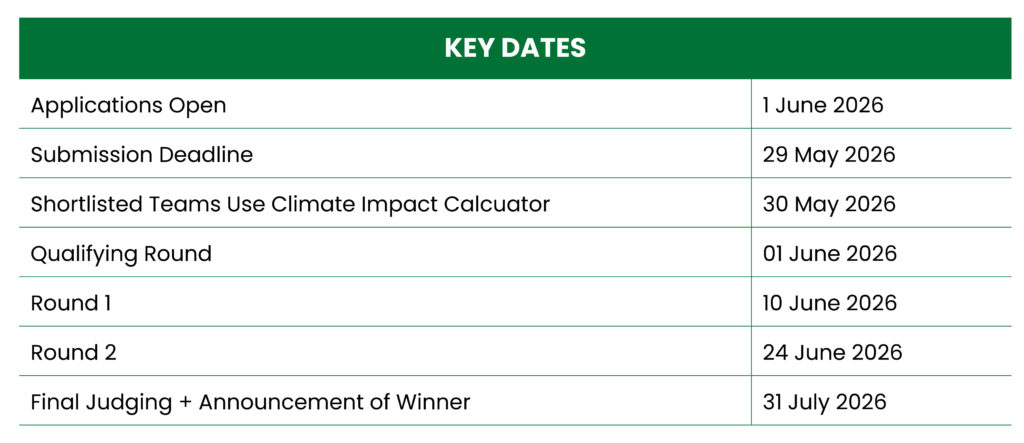
Frequently Asked Questions (FAQs)
Can individuals apply?
Yes; individuals, inventors and groups with functional prototypes are eligible.
Can registered SMEs apply?
Yes; early-stage and growth-stage enterprises are eligible.
Can international teams apply?
Yes; if you are committed to piloting your innovation in Namibia.
What stage should my solution be at?
We will consider idea-stage applicants, but commitment and traction matter including, proof of concept, a prototype or a first reference customer. One if not all of these will strengthen your application.
What is the Climate Impact Calculator requirement?
Selected semi-finalists must use the GCIP/UNIDO Climate Impact Calculator to estimate emissions impact and support impact measurement.
What language must I apply in?
All submissions must be made in English.
How many rounds are there?
There are five (5) rounds within the challenge. Registration, Qualifying Round, Semi-finals, Pitch Round and Final Presentation Round with Q&A.
Where do I submit?
All entries are submitted via the official platform: https://aicnamib.awardsplatform.com/
AIC Partners

Implemented by Basecamp Business Incubator, in partnership with the Network for Global Innovation (NGIN), Capricorn Foundation, and the United Nations Industrial Development Organization (UNIDO).
ABOUT THE CHALLENGE
The Agripreneurial Innovation Challenge is a national programme designed to identify, support and accelerate job-creating agricultural innovations and enterprises. It focuses on solutions that improve productivity and profitability, strengthen value chains, support climate resilience, and reduce dependence on imports, while prioritising ideas that can scale.
About the Partners
Basecamp Business Incubator Hub
Basecamp is a Namibian entrepreneurship support organisation building pathways for founders through programmes, mentorship and ecosystem partnerships.
NGIN (Network for Global Innovation)
NGIN is an international network of entrepreneurial support agents focused on accelerating the expansion of sustainable technologies, with the intent of generating significant economic growth in both developed and emerging markets.
Capricorn Foundation
The Capricorn Foundation serves as Capricorn Group’s vehicle for CSR initiatives, focusing on identifying or creating programmes and partnering with like-minded organisations to positively impact local communities within its chosen key investment areas.
UNIDO
UNIDO is a specialized United Nations agency with a unique mandate to promote inclusive and sustainable industrial development, supporting developing countries and emerging economies in building and transforming their industries.